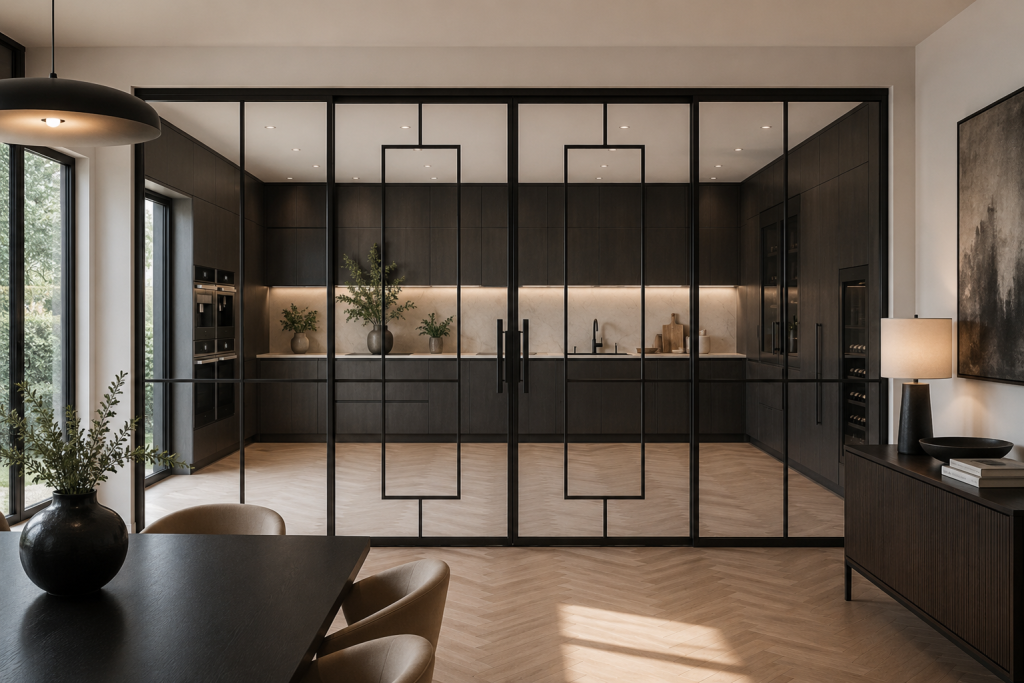
There’s a moment in almost every serious renovation when someone stands in a doorway and realises the decision they make here will define the entire feel of the house. Not the kitchen. Not the lighting. The door between the spaces.
More and more, the right answer is steel and glass.
Not because it’s fashionable. Because it’s correct.
A quick Nod to History
The aesthetic has roots in late Victorian industrial architecture: narrow steel profiles holding vast panes of glass in factories and glasshouses. Crittall, the Essex manufacturer founded in 1884, refined it into something domestic and elegant. Their frames turned up in Bauhaus-influenced houses, art deco conversions, modernist semis.
What’s changed is context. The steel-framed door has moved indoors, and instead of keeping the weather out, it’s doing something subtler: dividing space without closing it. Letting light through. Making a room feel considered rather than simply finished.
Why Steel
Steel can be welded. Joints are fused, not fastened, which means no visible fixings, no mechanical connectors, no sense of assembly. The frame reads as a single continuous object. It’s a quality of line that’s genuinely difficult to replicate by other means.
The Finish Is the Door
Powder coat is fine. Durable, consistent, available in any RAL colour you care to name. But it’s flat. What you see at noon is what you see at dusk. There’s no depth to it.
Patination is something else entirely.
Hot patinas, applied with chemical compounds at elevated temperatures, produce surfaces that shift. Bronzes that move from golden to near-black depending on the light. Aged blacks with a faint suggestion of blue or green beneath them. Raw steel sealed with wax that holds the natural tonal variation of the metal itself, every panel slightly different from the last.
This is not a paint finish. It’s a surface that looks like it has a history.
Against lime-washed plaster, a wax-sealed raw steel frame reads as simultaneously ancient and completely contemporary. In a Victorian house, an aged bronze patina will sit in the same tonal family as original brass hardware and cast iron fireplaces: not matching, but belonging. In a new-build extension, the same material brings warmth to a space that would otherwise feel clinical.
The finish is where most buyers under-invest, distracted by glass patterns and frame geometry. It’s actually the decision that determines whether you get a beautiful door or a remarkable one.
How shape changes the space
The grid-patterned flat door, what most people mean by Crittall-style, is the reliable choice. Clean, versatile, almost universally flattering. Hard to get wrong.
The arched door is harder to execute and more rewarding when it lands. A semi-circular or elliptical head references Georgian fanlights and ecclesiastical openings; fitted into an existing arched reveal, it looks like it was always there. In a rectangular opening, it’s a deliberate statement. Know which one you’re making.
Pivot doors are about ceremony. The weight of the panel, the deliberate arc of movement, the hardware: it all adds up to an entrance, not just an opening.
They suit large spaces with enough scale to justify them.
Glass partitions are the most underused option. An entire wall that filters light without blocking it, that separates a kitchen from a dining room or a study from a landing, without the finality of a solid wall. Done well, it’s one of the most intelligent spatial moves available to a residential project.
What to get right before you order
Measure the opening precisely. Bespoke steel frames are made to dimension and cannot be trimmed on site. Get your supplier to confirm the sizing before fabrication begins. This is not the place for optimism.
Glass specification deserves more thought than it usually gets. Toughened clear glass is the default, but reeded, fluted, smoked and frosted options all read differently and suit different contexts. The glass is half the visual equation.
And budget accordingly. Understand what you’re actually paying for. A well-made steel frame reflects fabrication skill, material quality and finish in a way off the shelf doors rarely can.
The people who get this decision right tend to have one thing in common: they treated the steel frame as the primary design element in the room, and let everything else follow from it.
That’s not a complicated idea. It just requires a bit of nerve.