
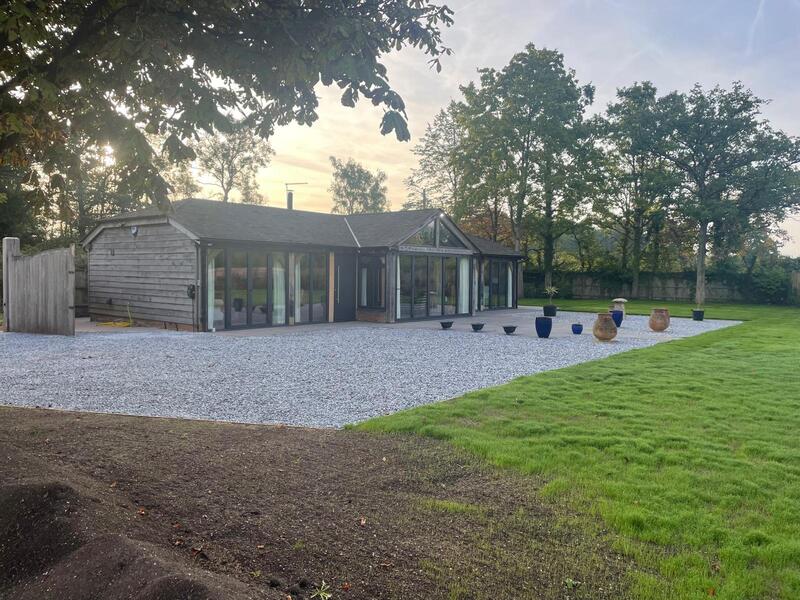
Project location: White Waltham, Berkshire
Barn conversions are a familiar sight across the British countryside. They come with instant character, beautiful proportions and a real sense of history. But they also come with one big challenge that almost every client raises early on:
“How do we get more light in without ruining what makes it a barn?”
That balance between heritage and modern living is exactly what this White Waltham project was about, and it serves as a perfect example of a successful Berkshire barn conversion.
The reality of converting a barn
Most traditional barns were never designed to be lived in. They were built to be robust, enclosed and practical – thick timber frames, solid walls and very few openings. Great for livestock – not so great for natural light.
When those structures become homes, the goal isn’t to turn them into glass boxes. It’s to make them comfortable, bright and liveable while still respecting their agricultural roots and the expectations of planners. The best barn conversions don’t fight the building – they work with it.
Old meets new: timber and aluminium working together
On this project, the original timber frame was always going to be the hero. Our job was to introduce modern glazing that enhanced it, rather than competing with it.
That’s where aluminium comes into its own.
Slim Origin aluminium frames allow for much larger glass areas without looking heavy or clumsy against timber. The contrast is intentional: weathered wood alongside crisp, precise glazing creates a quiet conversation between old and new. Nothing feels forced – nothing looks like it’s been “added on”.
Why anthracite grey works so well in barn conversions
The Origin aluminium frames here are finished in anthracite grey (RAL 7016), and that choice was very deliberate.
White frames can often feel out of place on rural buildings – they draw attention to themselves. Darker tones do the opposite. From a distance, anthracite frames visually recede, acting almost like a shadow line. Your eye is drawn instead to the timber structure, the roofline and the surrounding landscape.
It’s a subtle decision, but one that makes a huge difference to how the building sits in its setting.
The glazed gable: where light really changes the space
The glazed gable is the standout feature of this conversion.
By following the pitch of the roof, the glazing feels completely natural to the building rather than imposed on it. Inside, it transforms the space. High-level light pours into the heart of the barn, illuminating the vaulted ceiling and exposing the craftsmanship of the original timber frame.
It turns a structural element into a design feature – and once you’ve lived with that level of light, it’s hard to imagine the space without it.
Blurring the line between inside and out
Across the rear elevation, aluminium bi-folding doors were used to open the living spaces directly onto the patio.
When closed, the slim frames keep sightlines clean and uninterrupted. When open, the doors stack neatly away, removing entire sections of wall and creating a genuine connection between house and garden.
Details matter here. Flush thresholds were specified so the floor level flows seamlessly from inside to out. No awkward steps – no visual breaks – just one continuous space that works year-round.
Performance without compromise
Aluminium gives us the structural strength to create far wider and taller openings than most materials will comfortably allow, without adding visual bulk. That’s how we achieve expansive glazed elevations and full-height bi-folding doors that still feel refined and in proportion with the building.
Where projects call for it, triple glazing is also available. This is particularly effective in barns, where managing heat loss, solar gain and internal comfort is just as important as maximising light. The result is a space that feels calm and stable year-round.
Security is built into the system rather than added as an afterthought. Despite the openness of the design, the building retains the solidity you’d expect from a permanent rural home.
Final thoughts
A barn conversion isn’t about erasing history – it’s about giving it a future.
This White Waltham project shows what’s possible when glazing is designed as part of the architecture, not bolted on at the end. The result is a home that feels calm, considered and completely at ease with its surroundings.
If you’re planning a barn conversion and want advice on how to maximise light while respecting the character of the building, we’d love to help. Whether you’re still navigating planning or ready to finalise specifications, our team can guide you through the options.
Get in touch with FENX to start the conversation, or explore our gallery to see more completed projects.